Cross-Agent Memory Sharing
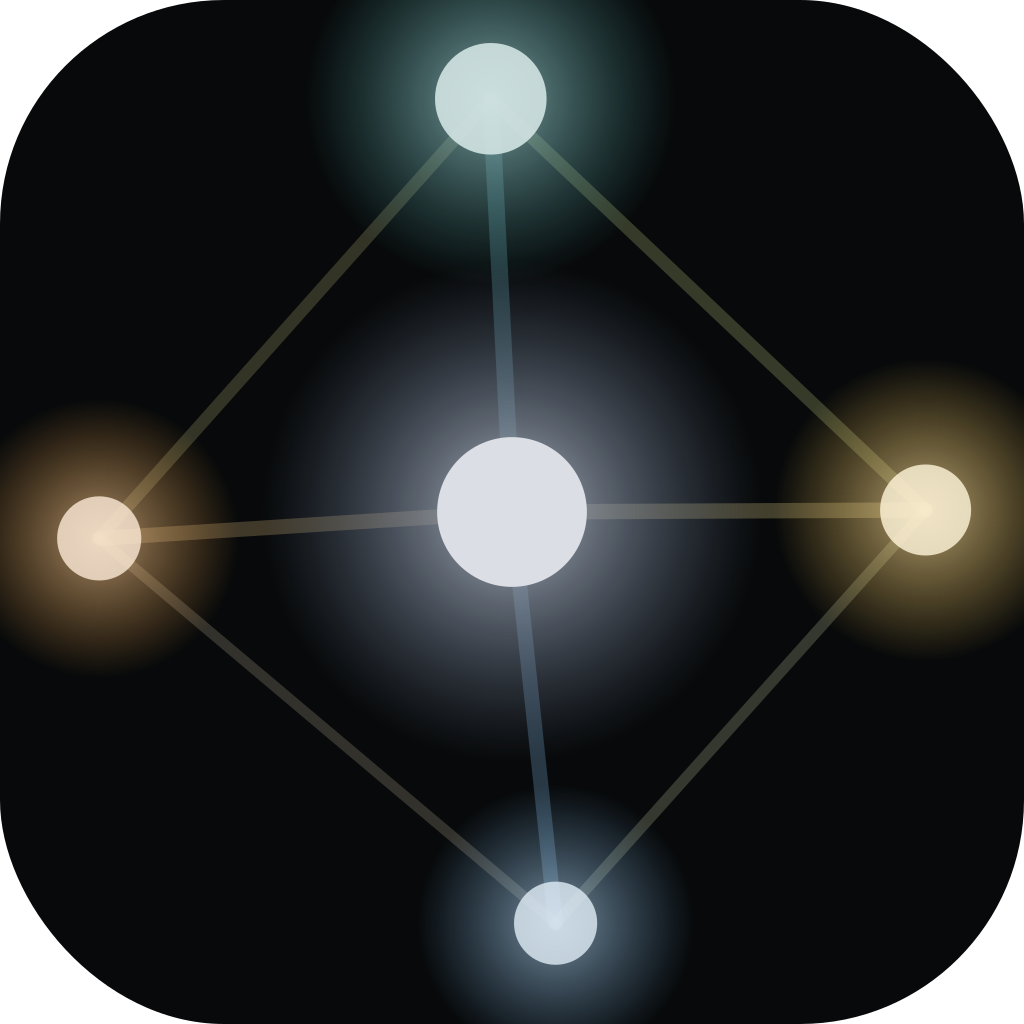
Brain Memory uses a single global directory — ~/.brain/ — that is shared across all supported AI agents. A decision stored by Claude Code in one project is immediately available to OpenAI Codex CLI, OpenCode, or Antigravity in any other project, with no configuration, no export, and no per-project setup. The same brain is also reachable from the Claude.ai and ChatGPT apps through the hosted MCP connector.
Model-Agnostic, Too
Portability runs along two independent axes:
- Agent-portable — the supported agents (Claude Code, OpenAI Codex CLI, OpenCode, Antigravity) all read and write the same brain.
- Model-agnostic — because memory is plain files, not embeddings welded to a particular model, the LLM driving your agent can be anything (GPT, Claude, Gemini, or any model routed through a gateway). Switching the underlying model changes nothing about your memory.
Put together: switch your model or switch your agent, and you keep remembering — pick up exactly where you left off.
How It Works
All supported agents read and write to the same ~/.brain/ directory:
~/.brain/                          ← Single shared directory
├── index.json                     ← Shared index
├── associations.json              ← Shared associative network
├── contexts.json                  ← Session contexts from all agents
├── professional/
│   └── decisions/
│       └── chose-kafka.md         ← Created by Claude Code
├── personal/
│   └── education/
│       └── rust-ownership.md      ← Created by Codex CLI
├── professional/
│   └── learnings/
│       └── async-pitfalls.md      ← Created by OpenCode
└── ...
The format is agent-agnostic: plain Markdown files with YAML frontmatter. Any tool that can read Markdown can read your brain.
Agent-Agnostic Format
Brain Memory deliberately avoids any agent-specific constructs:
| Component | Format | Why |
|---|---|---|
| Memory files | Markdown with YAML frontmatter | Universal, human-readable |
| Index | JSON | Supported by every language and tool |
| Associations | JSON | Simple weighted edge graph |
| Configuration | JSON (in index.json) | No proprietary config format |
| Directory structure | Plain filesystem | Works on macOS, Linux, Windows |
No vendor lock-in. No proprietary binary formats. Your memories are yours.
What Gets Shared
Everything in ~/.brain/ is automatically shared:
- Memories — All memory files, regardless of which agent created them
- Associations — The full associative network, including links created by different agents
- Index — The central registry with all memory metadata
- Configuration — Brain settings apply to all agents uniformly
- Review queue — Spaced repetition schedule works across agents
- Contexts — Session context history from all agents (labeled by source)
What Does Not Get Shared
- Agent configuration — Each agent's command prompts and prompt sections are installed separately in their own config directories (
~/.claude/,~/.codex/,~/.config/opencode/,~/.gemini/), as are thebrainplugin and its hooks on Claude Code and Codex - Session state — Each agent maintains its own session context during active use
- Sync state — The
~/.brain/.sync/directory is local and agent-independent
Cross-Agent Scenarios
Scenario 1: Claude Code creates, Codex CLI recalls
- You work on a project with Claude Code and run
/brain:memorize - Claude Code stores a decision memory in
~/.brain/professional/ - Later, you open a different project with Codex CLI
- Codex CLI loads the brain at session start and sees the memory
- When the topic comes up, Codex CLI references it naturally
Scenario 2: Multiple agents in the same session
- You use Claude Code to analyze a codebase and memorize findings
- You switch to OpenCode for a different task in the same project
- Both agents share the same brain — OpenCode sees what Claude stored
- OpenCode adds its own memories, which Claude Code will see next time
Scenario 3: Review queue across agents
/brain:sleepis run from Claude Code, populating the review queue- You open Codex CLI and run
/brain:sleep - Its replay pass uses the same queue generated by Claude Code
- Recalled memories are reinforced regardless of which agent does the review
No Configuration Needed
Cross-agent sharing requires no setup beyond installing Brain Memory for each agent. Since all agents read from and write to ~/.brain/, sharing is automatic.
The only requirement is that each agent has its own command prompts installed. During installation, you can choose to install for multiple agents at once:
npm install -g brain-memory
brain --all --global
This installs the CLI tools and configures command prompts for Claude Code, OpenAI Codex CLI, OpenCode, and Antigravity simultaneously, all pointing to the same ~/.brain/ directory.
Claude Code and Codex can take the brain plugin instead. It ships the same /brain:* commands plus three deterministic hooks shared by both hosts — SessionStart, UserPromptSubmit, SessionEnd — so session-start context and prompt-time recall are injected by the host rather than left to the model. brain --codex registers the same hooks in ~/.codex/hooks.json. Either way, the brain underneath is the same directory.
Each agent has slightly different command syntax (slash commands for Claude Code and OpenCode, skills for Codex and Antigravity), but they all operate on the same underlying brain structure and data format.
Identical, deterministic recall across agents relies on the brain CLI being on your PATH — always install with npm install -g (not npx), so every agent shells out to the same scoring engine instead of falling back to manual file operations.
If you primarily use one agent but occasionally switch to another, your brain context follows you seamlessly. There is no migration or export step — just start using the other agent.
Human Access
Because the format is plain Markdown, you can also browse and edit your brain directly:
- Open
~/.brain/in VS Code, Obsidian, or any file explorer - Read memory files with any text editor
- Search across memories with
grepor your editor's search - Edit memories manually if needed (be careful with frontmatter format)
- Use Git to track changes:
cd ~/.brain && git init && git add -A && git commit -m "snapshot"
Your brain is not locked inside any tool — it is always accessible.